Ageless Grace®: An Evidence-Informed Brain & Body Fitness Program
What is Ageless Grace®?
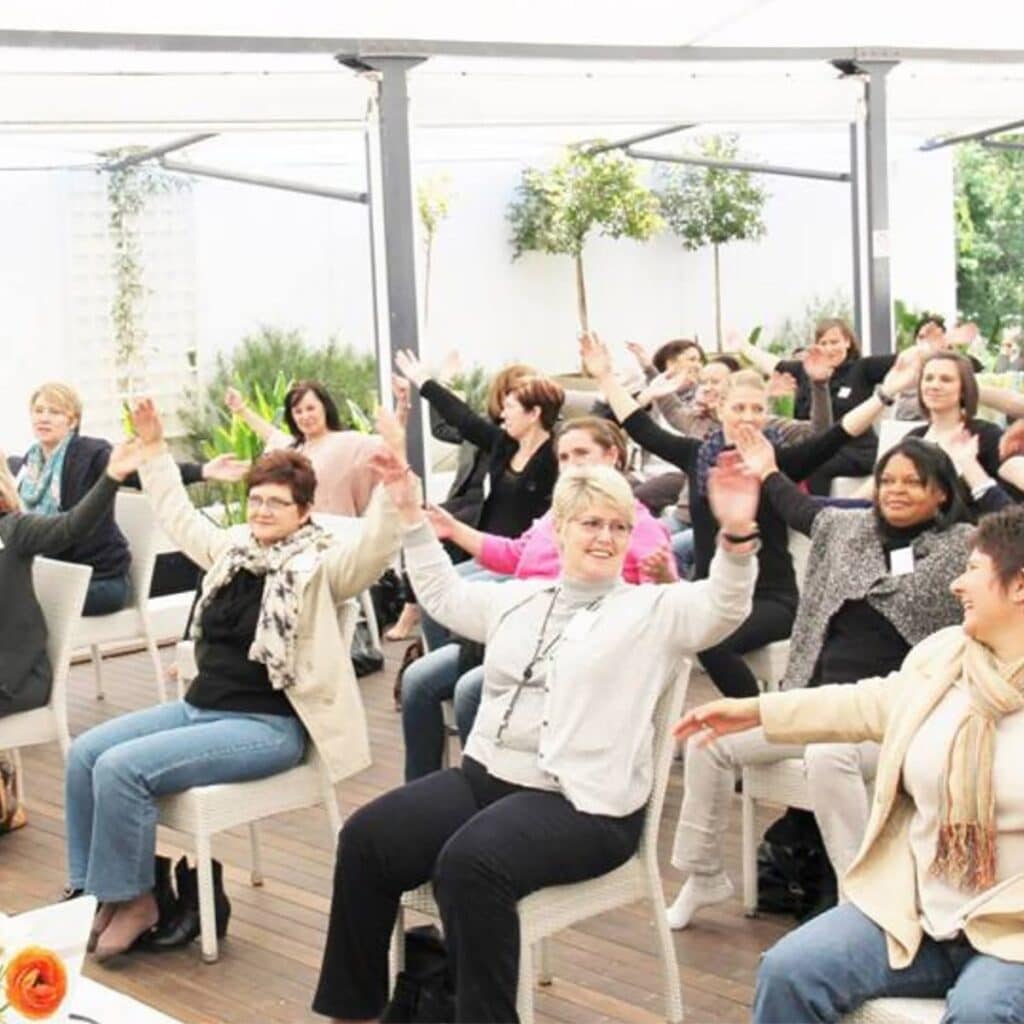
Ageless Grace® is a mind-body program designed to stimulate neuroplasticity – the ability of the brain and nervous system to change structurally and functionally. It is performed in a chair that keeps participants moving and thinking through the power of play, set to fun music, addressing 21 physical skills and 5 functions of the brain needed for lifelong optimal function.
21 Simple Tools for Lifelong Comfort and Ease™ (21 Simple Tools) is its trademarked exercise framework, created by Denise Medved, curated by applying evidence-informed research where each tool addresses a primary factor related to physical aging and supports cognitive health by activating all five primary functions of the brain: strategic planning, memory and recall, analytical thinking, creativity and imagination, and kinesthetic awareness while also challenging the physiological variables of endurance, strength, power, flexibility, coordination and more. The experience evolves toward a playful, expressive, and emotive approach to movement that engages the participant’s heart and mind as much as their body.
The seated nature of the program helps the brain learn to perform certain activities seated rather than standing, and it also allows individuals with limited physical function or chronic disease conditions to participate at their own level of ability. Ideally, the program is intended to be preventative, encouraging personal practice for 10 minutes daily to stem the effects of cognitive decline associated with aging by combining full-body strengthening with cognitive challenges (dual-tasking). Older adults over 60, individuals at increased risk for falls, persons with disabilities, mild cognitive decline or with dementia, Alzheimer’s or Parkinson’s diseases, and persons who have had a stroke can benefit from program intervention.
It’s never too late to begin. It’s never too early to start.™ Children utilize movement to create the foundation of their neurological system. Ageless Grace® 4EverFit4KIDZ! provides opportunities to perform the necessary movements to develop and refine bilateral integration, eye-hand coordination, sensory processing, and more using the 21 Simple Tools. Ageless Grace® is intergenerational and Timeless Fitness for the Body and Brain™.
Ageless Grace® Evidence-Informed Exercise Framework
21 Simple Tools for Lifelong Comfort and Ease™ (21 Simple Tools) is the trademarked exercise framework of Ageless Grace®, created by Denise Medved over a 7-year span working with a Duke–affiliated hospital and a university graduate department, curated by applying evidence-informed research where each tool addresses a primary factor related to physical aging and supports cognitive health by activating all five primary functions of the brain.
Each tool is supported by neuroscience, exercise physiology, gerontology, and cognitive health research from peer-reviewed studies, clinical guidance, and expert commentary from respected medical and academic institutions. For further exploration, a collection of various media types is cited in the 21 Simple Tools Reading List.
https://agelessgrace.com/wp-content/uploads/2018/10/Ageless-Grace-21-Tools-Resources.pdf
Ageless Grace® as an Evidence-Based Program Intervention
Ageless Grace®, as an evidence-based program, is delivered over 60-minute sessions three times weekly over five weeks; or 45-minute sessions three times weekly over nine weeks; or other adaptations in-person in a community setting or in-person online, where a Certified Ageless Grace® Educator (Educator) guides a group rotating through its 21 Simple Tools for Lifelong Comfort and Ease™ (21 Simple Tools). Throughout the program, participants are encouraged to practice at home for at least 10 minutes a day, 4 days per week, and to keep a log of the 21 Simple Tools practiced. Companion videos and manuals may be made available to participants to reinforce the exercise framework as they begin to develop the habit of practicing. The community setting allows for the sharing of lifestyle integration methods as well as additional encouragement from peers.
As an intervention, the implementing organization’s site administers the program based on the needs of the population, and the Educator’s role is to lead an engaging, quality practice. Outcomes are measured using pre- and post-intervention standardized, self-reporting surveys, similar to those used in the supporting research.
Ageless Grace® Evidence-based Intervention Research – Target Populations and Outcomes
Target Populations:
- Those who have had a stroke
- Mild cognitive decline
- Parkinson’s, Alzheimer’s, and Dementia
- Chronic diseases or disabilities
- Older adults over age 60
Outcomes:
- Improved physical function
- Increased mobility
- Improved balance
- Improved cognition
Ageless Grace® Evidence-based Health Promotion Program
The Arkansas Department of Human Services – Division of Aging, Adult and Behavioral Health Services has determined that Ageless Grace meets the criteria provided by the United States Department of Health and Human Services – Administration for Community Living (ACL) for an evidence-based health promotion program. The determination qualifies Ageless Grace to be funded through the Older Americans Act Title IIID at the highest level.
Published Research on Ageless Grace®
The most current research on Ageless Grace® may be found by searching the PubMed® database, a repository hosted by the National Institutes of Health, National Library of Medicine, National Center for Biotechnology Information.
https://pmc.ncbi.nlm.nih.gov/search/?term=%22Ageless+Grace%22&sort=relevance
Excerpts from published research on Ageless Grace®
Study: Thielman, Roos (2025). A telehealth exercise program to improve cognition in people with stroke.” Click here for Full Text 2025 Study
“A telehealth exercise program to improve cognition in people with stroke” (Thielman G, Roos M, 2025 Sci. Rep. Jul 1 2025;15(1)21109, PMC12219590) cites, the incidence of post-stroke cognitive dysfunction ranging from 20-80% becomes apparent when performing two activities simultaneously “dual-tasking” either at home (example: standing and preparing meal) or interacting in the community (example: walking and filling grocery cart). With cognitive motor interference (CMI), persons with stroke may prioritize one of the tasks (cognitive motor trade-off), perform both tasks poorly, fail to complete a task, or fall in the process. Researchers concluded that in individuals with stroke, the telehealth exercise program Ageless Grace® used in this study for cognitive rehabilitation training is safe and efficient in improving one’s ability to perform daily functional activities with dual tasking.
More specifically, using Ageless Grace® as an intervention for 15 one-hour tele-health sessions delivered three times weekly over five weeks, both groups, Subjects Post Stroke (SPS) and Healthy Older Adults (HOA), reported improved confidence performing balance-specific activities. The most significant results were the 2 Minute Walk Test (2MWT and the 30-second Sit to Stand Test (30STS), with both groups improving in the standard task as well as when combined with a cognitive Verbal Fluency Test (VFT) for the 30STS.
https://pmc.ncbi.nlm.nih.gov/articles/PMC12219590/pdf/41598_2025_Article_7064.pdf
Study: Sipes, Mathis, Killin, Taylor (2020). “Physical and Cognitive Evaluation of a Neuroplasticity Exercise Program: A Pilot Study” Click Here for Full Text Study
“Physical and Cognitive Evaluation of a Neuroplasticity Exercise Program: A Pilot Study” (Cody L Sipe, et al, HSOA J Gerontol Geriatr Med 2020 6: 065) cites that the simultaneous combination of physical exercise with cognitive challenges tends to produce greater results than either cognitive or physical interventions performed separately. Researchers concluded that Ageless Grace® was a promising intervention for improving both physical and cognitive function in older adults and that its seated nature allows individuals with limited physical function or with chronic disease conditions to participate and potentially benefit.
This quasi-experimental exercise intervention study was conducted in a residential retirement community setting, meeting three times weekly over nine weeks, a total of 27 sessions, ranging from 40-50 minutes each. Each class consisted of performing 12 of the 21 Simple Tools for Lifelong Comfort and Ease™, Ageless Grace’s trademarked framework for exercise, randomized to ensure equitable utilization throughout the 27 sessions, for approximately 3-4 minutes each, corresponding with the length of the song that was chosen for each tool from a wide variety of styles and genres. The study yielded 91% attendance, and statistically significant improvements were found in multiple areas of physical and cognitive function, indicating that the program is effective. Overall, statistically significant improvements included improved physical function, mobility, balance, and cognition. The researchers noted the average age in this study was 85.4 and that these subjects were functioning as well as or slightly better than individuals up to or more than a decade younger than them following the intervention.